The Angelic Archive Series
Star Walkers
Across the stars, humanity’s forgotten history is waking.
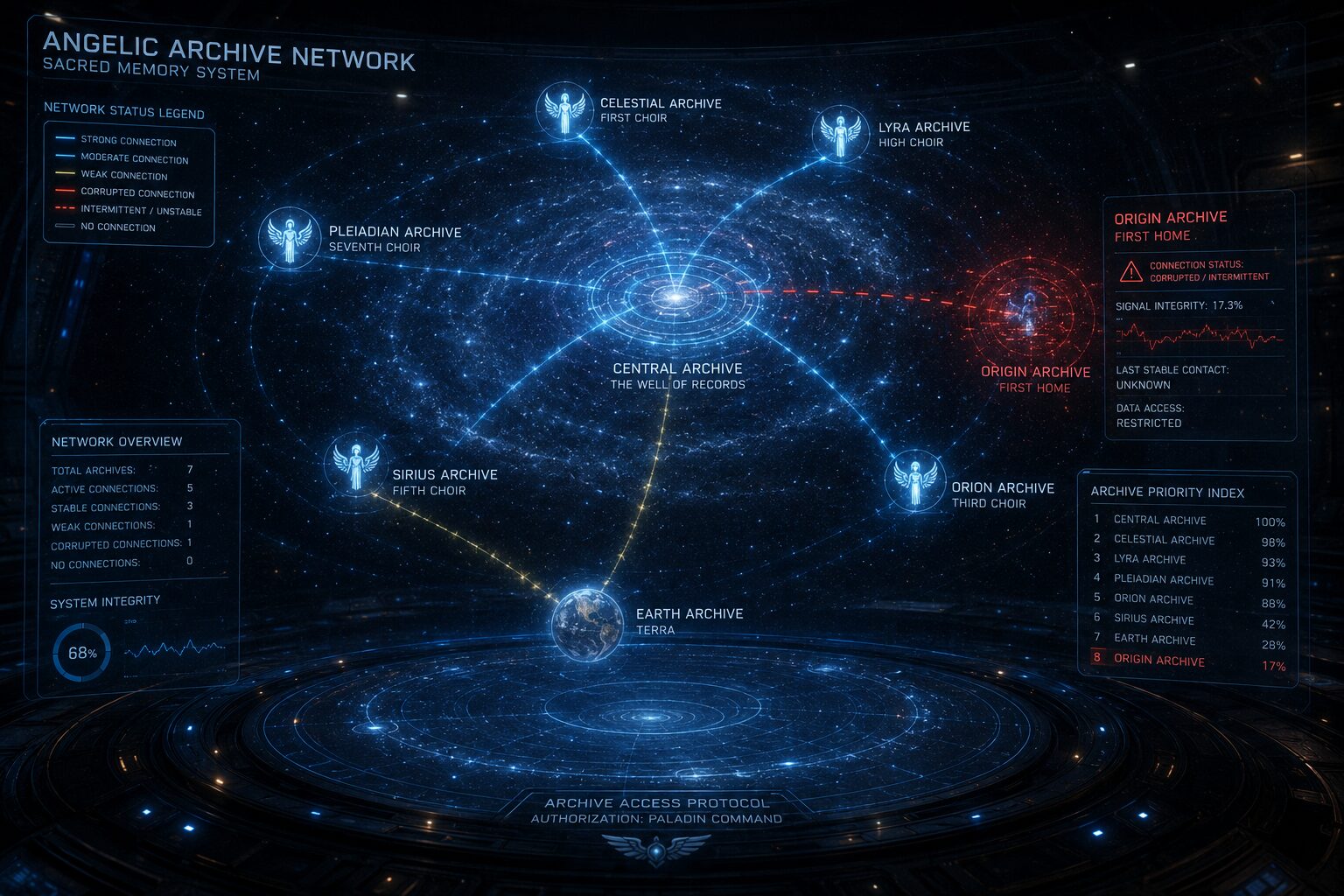
When Captain Jemael Orreaga, Maraphina Orreaga, and their daughter Luci encounter the first Angelic Archive, they uncover a truth older than Earth: humanity was once one family, spread across many worlds and connected by a living network of memory, frequency, and sacred technology. But an ancient rupture shattered that unity, scattering the children of light across the galaxy and turning lost kin into enemies. The Draconians are not alien invaders. They are family who forgot.
Now the archives are calling them home.
Guided by angelic envoys, ancient star maps, and a commission sealed long before this lifetime, the Orreaga family must awaken the royal-star archives, restore the broken nodes, and follow the trail toward Origin — the first home of humanity. What they discover will rewrite history, challenge every definition of enemy and family, and reveal that “Come home” is not a plea. It is prophecy.
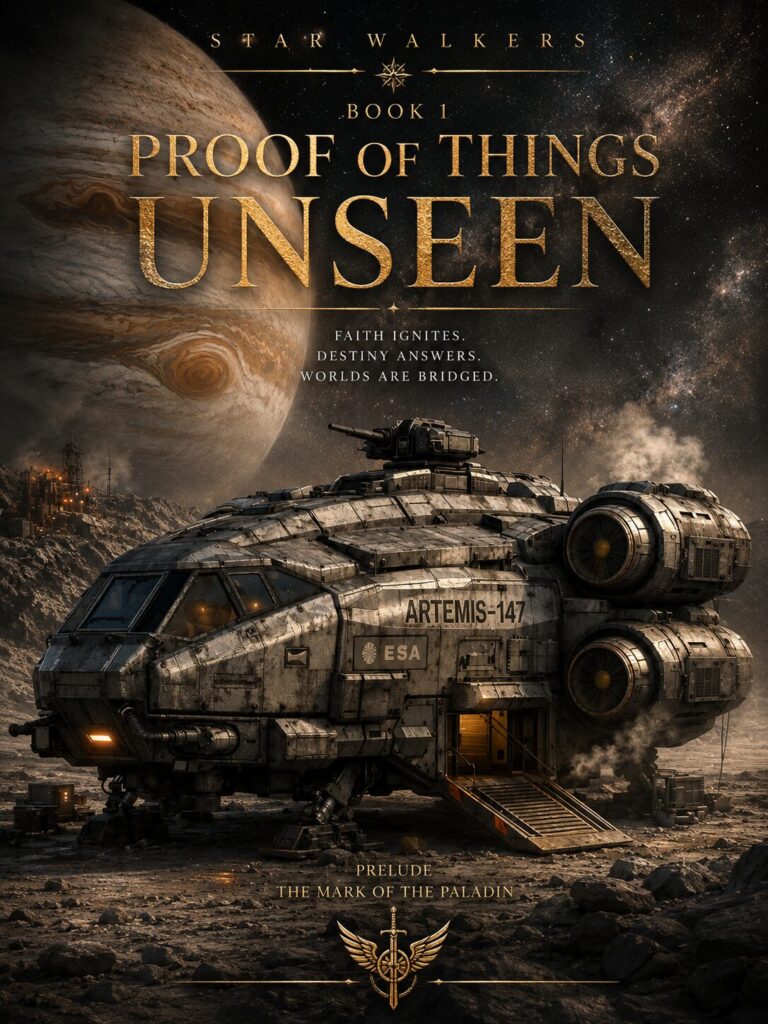
Star-Walkers Book 1 of the angelic archive series
The Proof Of Things Unseen
A scar. A rescue. A command he never forgot.
Years after surviving Titan Outpost through an impossible flash of blue-white light, Jemael Orreaga is drawn into a crisis in the Rigel system that will change the course of humanity. A destroyed ESA vessel, a hidden Draconian truth, an ancient chamber beneath the Sphinx, and a newly launched starship all converge around one family: Jemael, Maraphina, and Luci.
As the USS Archangel races toward secrets buried beneath ice and silence, the Orreagas discover that faith, science, love, and command are not separate paths, they are pieces of the same map. What begins as a rescue mission becomes a revelation: the enemy may be human, the past may not be past, and unseen forces have been guiding them from the beginning.
By the end, the first Angelic Archive opens, and the story that began with a scar arrives at its true beginning.
Star-Walkers Book 1 of the angelic archive series
Prelude: The Mark of The Paladin
The corridors of JSOC Luna felt strangely familiar after three weeks away — not because anything had changed, but because he had.
Jemael adjusted the duffel bag slung over one shoulder and stepped through Security Checkpoint Three toward Rescue Operations. The low gravity of Luna tugged at his stride in the old familiar way, lighter than Earth but present enough to remind the body where it was. Polished floors caught the soft white lighting; the air carried the faint metallic scent of recycling; voices murmured over comms beneath the rhythm of boots on composite decking. Duty, he had long ago decided, had its own atmosphere — and after three weeks of breathing something gentler, walking back into it felt like putting on a uniform that still fit but no longer told the whole truth about the man wearing it.
Three weeks. The longest vacation he had taken in years. Three weeks to help Luci settle into the ranch; three weeks to stop being “Dad in theory” and start learning how to be Dad in practice; three weeks of discovering that assembling furniture designed for children required the patience of saints, the vocabulary of shipyard mechanics, and a spouse willing to pretend she had not heard at least half of it.
“Well, look who survived.”
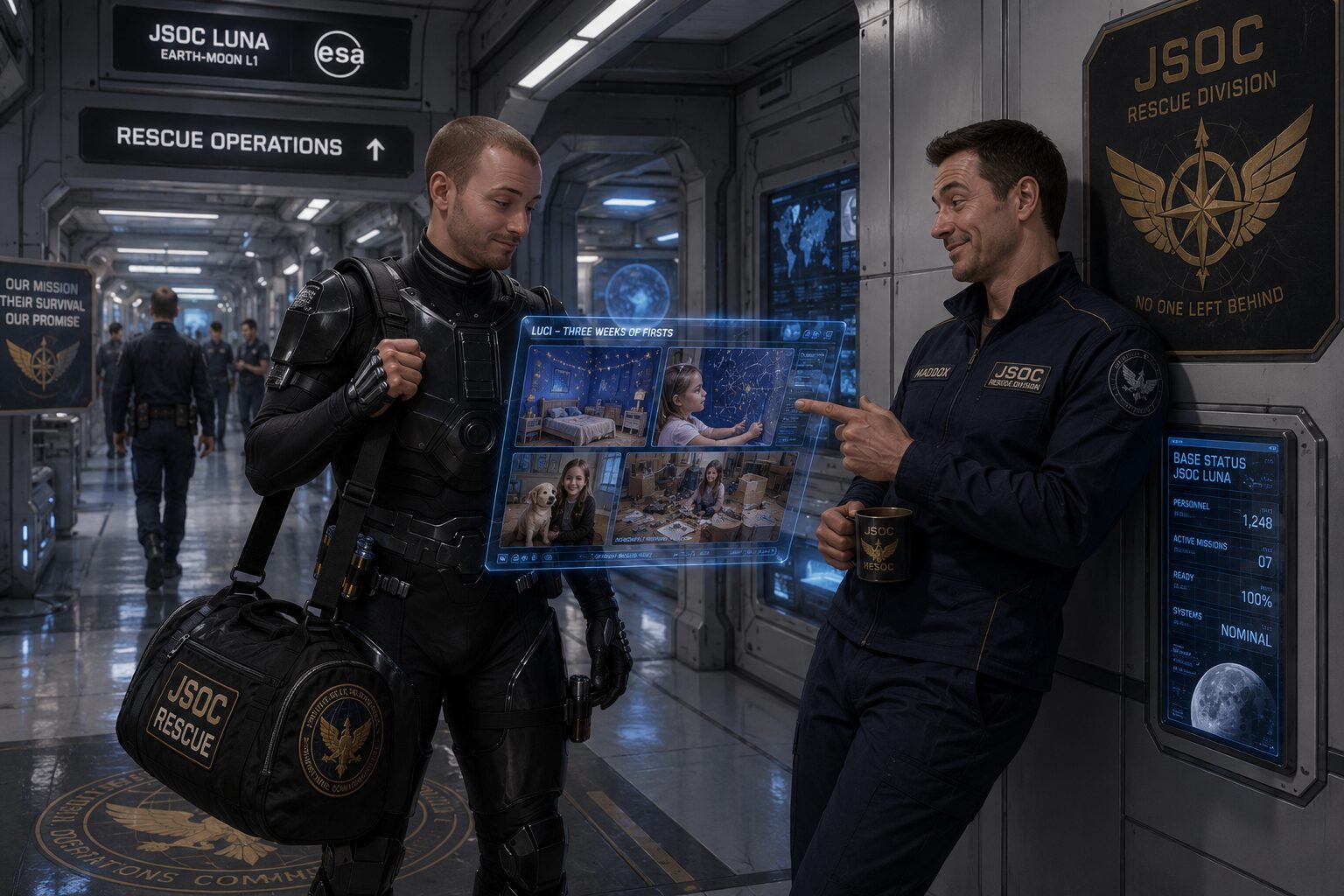
Jemael turned. Lieutenant Eric Maddox leaned against the corridor wall outside Rescue Operations, cradling a coffee mug that looked older than some ESA vessels. He was broad-shouldered and sharp-eyed, wearing the expression of a man who had been waiting all morning for the privilege of being irritating.
“Morning, Maddox.”
Maddox studied him with open suspicion. “You look rested.”
“I am rested.”
“That’s unnatural.”
Jemael laughed despite himself, and Maddox fell into step beside him with the easy timing of a man who had walked a hundred corridors at his shoulder. “So?”
“So what?”
“The kid.”
Jemael smiled before he could stop himself, and Maddox pointed at him in immediate triumph. “There it is.”
“What?”
“That smile. The one Maraphina gets whenever someone mentions either of you.”
“You spend too much time around us,” Jemael said, shaking his head.
“I work with you.”
“My condolences.”
“Accepted.” Maddox sipped his coffee. “So how’d it go? Luci settle in?”
In answer, Jemael reached into his pocket and pulled out his datapad. Maddox groaned the groan of a man who knew exactly what was coming and had no intention of escaping it.
The first image bloomed above the screen: Luci’s bedroom. Deep sapphire walls. Constellation lighting strung like a captive night sky. Custom shelving with the books already arranged, crystal display cases, and a desk large enough to command a small fleet from.
Maddox stared. Then stared harder. Then looked at Jemael. “So Maraphina designed it, then.”
“Yes.”
“I can tell.”
“How?”
“Because it’s beautiful.”
Jemael swiped to the next image — a reading nook beneath a curved window, plants and soft lighting and hand-painted star maps, a thick blanket folded over a chair in exactly the sort of way that suggested Maraphina had arranged it and Luci would rearrange it within the hour.
“Definitely Maraphina,” Maddox said.
The third image was less dignified: a half-assembled bookshelf surrounded by scattered tools, and Jemael himself sitting cross-legged on the floor, staring at the instruction sheet with an expression of open betrayal. Behind them stood Maraphina, wearing the look of a woman reconsidering every choice that had led her to love a man who believed furniture could be intimidated into obedience.
Maddox nearly spit his coffee. “Oh, that’s fantastic.”
“It was not fantastic.”
“You look furious.”
“I was furious. The instructions said Step Seven.” Jemael let the pause do its work. “There were six steps.”
Maddox stopped walking. “You’re making that up.”
“I wish I was. Maraphina found the missing page — inside the bookshelf.”
Maddox wheezed. “That’s evil.”
“It gets worse. She made me apologize to the bookshelf.”
“No, she didn’t.”
“She absolutely did.” Jemael sighed, a man surrendering to the truth. “And the bookshelf worked afterward.”
Maddox blinked at him, searching his face for the joke and not finding one. “You’re serious.”
“I am unfortunately serious.”
They walked on, and the laughter settled into something quieter and more comfortable — the kind of silence only old crewmates can share. Then Maddox asked the real question, the one the banter had been circling all along.
“How’s she doing?”
Jemael looked down at the datapad. The next picture showed Luci asleep on the couch beneath a blanket, one hand resting on a book, hair fallen across her face, one sock half-off — completely surrendered to the safety of the room around her. Home. Safe. Belonging.
His smile softened. “Good.”
“Yeah?”
“Yeah.”
The word carried more weight than Maddox expected, and Jemael let it. Three weeks ago, Luci had arrived with boxes. Now she walked through the house like she had always lived there. It was the small things that undid him: a mug left beside the sink. Cabinet space quietly claimed. Arguments about proper tool storage that she usually won. Falling asleep during movie night. Walking into the kitchen in the morning without asking where anything was. Little things. Family things. Things that mattered.
Maddox saw all of it move across his face. “That’s good, buddy.”
“It is.” Jemael looked at the image a second longer, then locked the datapad and slipped it into his pocket. “I was nervous,” he admitted.
“About Luci?”
“About me.”
That quieted the corridor between them. Jemael kept his eyes forward.
“I know how to lead a rescue team. I know how to make calls under pressure. I know how to get people out when the structure is failing and the clock is being cruel.” He paused. “I didn’t know if I knew how to be what she needed every day.”
Maddox did not answer too fast. For all his banter, he was never careless with the things that mattered. “And?”
Jemael thought of Luci standing in her new room, touching the desk, the shelves, the painted stars — and of the single word she had said. Home. His throat tightened just enough to annoy him.
“I’m learning.”
Maddox nodded. “Sounds like she is too.” He lifted his coffee in a small salute. “To surviving fatherhood.”
Jemael smiled. “I’ll drink to that when you find better coffee.”
“That hurts.”
“It should.”
The emergency klaxon sounded, and everything changed instantly.
Both men froze. A second later the overhead speakers crackled to life: “All Rescue Division personnel report immediately to Briefing Room Alpha. Emergency response activation. Repeat: all Rescue Division personnel report immediately.”
Maddox and Jemael exchanged a single look. Vacation was over. Something was wrong — very wrong.
Jemael slipped the datapad fully into his jacket pocket, and with it the picture of Luci disappeared. The father became the rescue officer again.
“Let’s go.”
Neither man ran; professionals never did. But they moved fast, and by the time they reached Briefing Room Alpha, the joking, furniture-building father had vanished behind the focused expression his crews knew well.
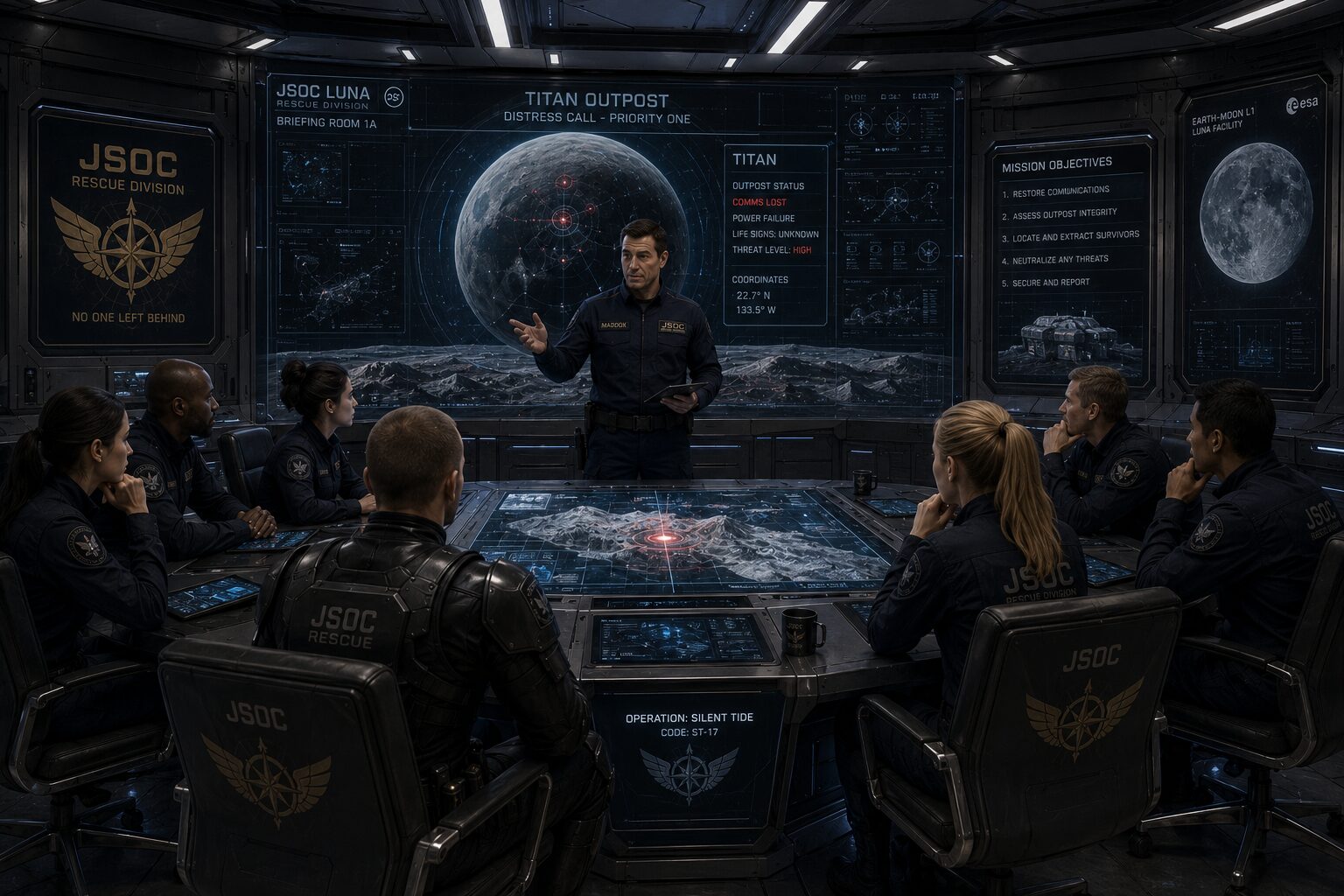
Jemael stood near the briefing room entrance, arms crossed, jaw set, the orders replaying in his mind like a curse: Report to JSOC Luna for a classified mission. Classified. The word grated at his soul.
The door slid open with a hush of pressurized air, and Colonel John Montroy, JSOC Commander, stepped in with the unhurried weight of a man who carried command the way other men carried grief. He caught Jemael’s disapproval with a single glance.
“Have a seat,” Montroy said, firm and unyielding.
Jemael hesitated.
“That’s an order, Lieutenant.”
He sat, bracing for the inevitable.
“What you’re about to hear is classified beyond top secret,” Montroy began. “Thirty minutes ago, Titan Outpost suffered a catastrophic structural failure. A test of new stealth technology temporarily phase-shifted the lab’s outer bulkhead, exposing it to vacuum. The decompression explosion shattered the station’s structural integrity.” His eyes moved across the room, steady as a metronome. “Your mission: immediate evacuation of all personnel, and retrieval of research if possible. This is a civilian facility. There are children on board. Time is your only enemy. Suit up. Mission launch in ten. Arrival at Titan in thirty.”
The seven-person team filed out without debate or bravado. This wasn’t combat; it was rescue. The only enemy was time, and there was no weapon for that except speed.
In less than five minutes Jemael and his squad were launch-ready. He turned to Montroy. “What’s the headcount?”
“Twenty adults, five children. Youngest is three.”
Jemael bit back his frustration. “What the hell is a three-year-old doing on a top secret R&D facility?”
Montroy’s jaw tightened. “Ask me later. Right now — focus.”
“Yes, sir.”
Jemael strapped in at the rear of the Artemis-class shuttle as it roared to life. Overhead, a holoprojector flickered on, rendering Titan Outpost in merciless detail: a mangled structure canted to one side, a gaping wound torn in its hull, the port airlock blinking amber like a failing pulse.
“Port airlock’s our only shot,” he briefed his team. “It was mid-maintenance when the accident hit — functionality unknown. Starboard airlock is gone. Stay sharp, stay together, eyes on the mission. There are children in there. That’s our priority.”
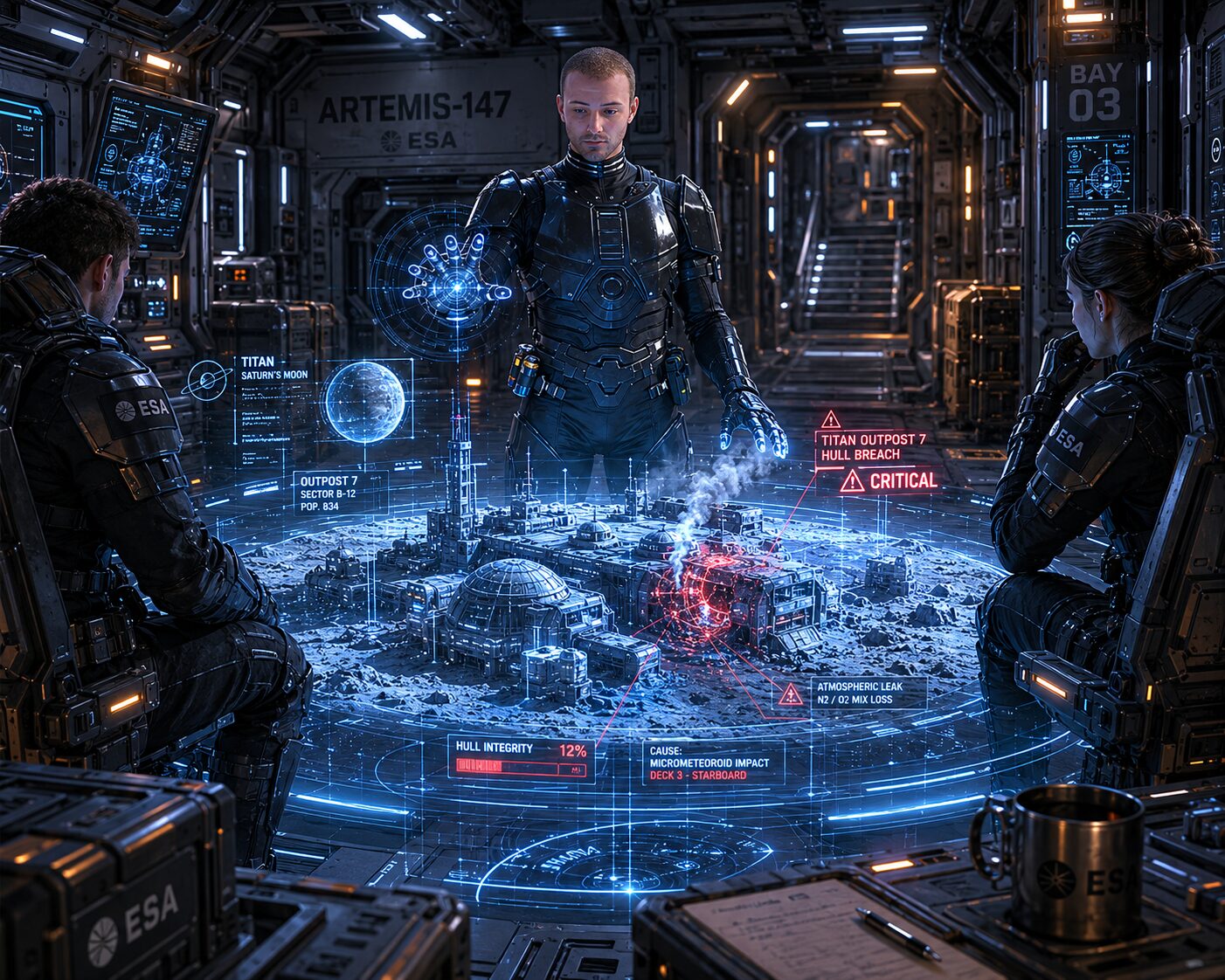
The rest of the flight passed in the particular quiet of professionals preparing for the worst — each checking their own gear, then each other’s. At last the pilot’s voice crackled over comms: “Approaching Titan port airlock. Brace for rough docking.” The impact juddered through their seats. Airlock secured.
The team moved out, three pairs sweeping the outpost while Jemael and his medic partner pushed toward the inner core. The sirens were relentless — red strobes, smoke, panic — and his voice cut through all of it.
“Evacuate! Everyone to the port airlock! Move! Move! Move!”
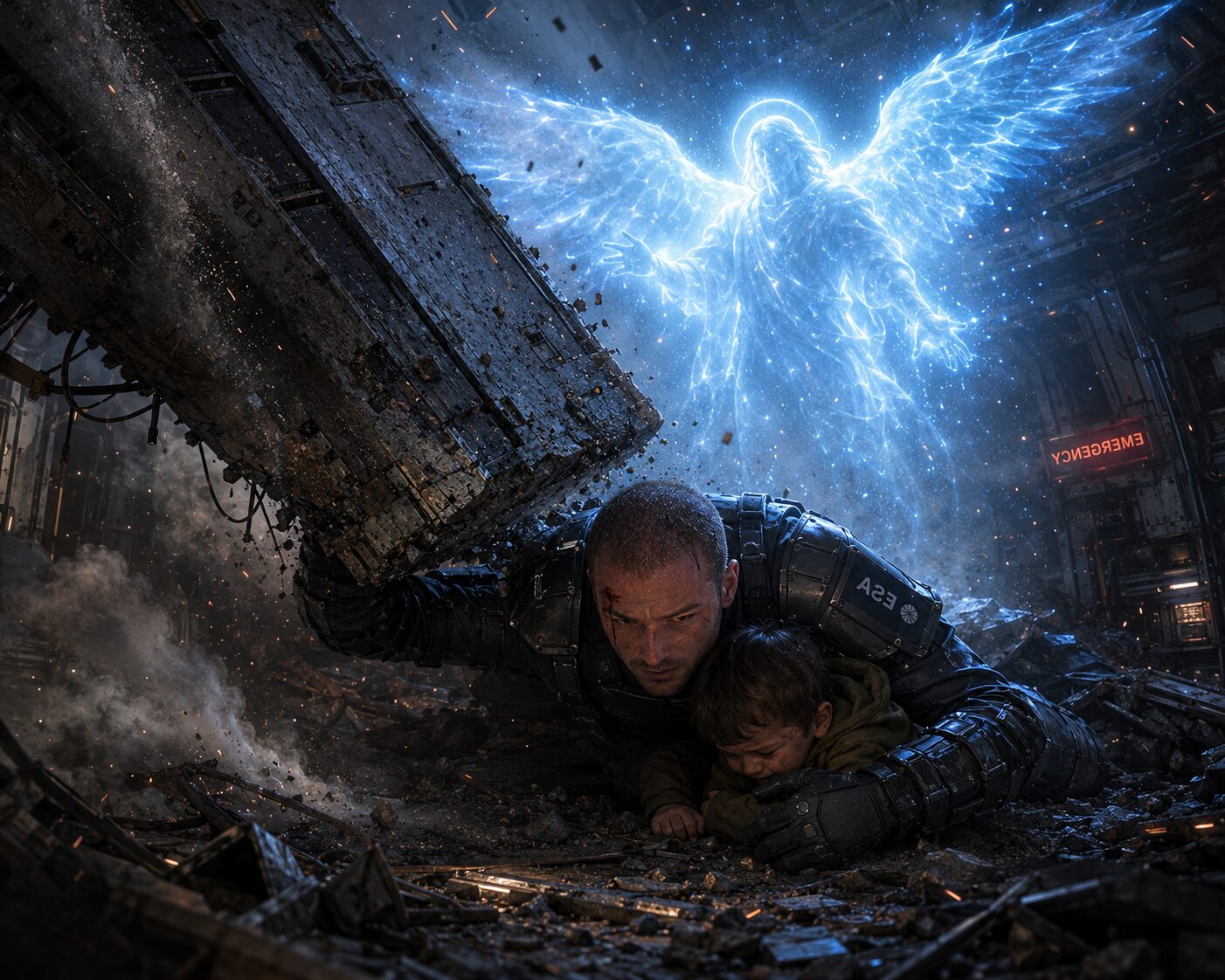
He slung the last unconscious technician over his shoulder, lungs burning, muscles numb with adrenaline, and was turning for the exit when a vibration rolled through the deck. A warning. Structural collapse, imminent.
Then — a flicker in his periphery. A child, maybe three years old, trapped beneath warped decking, terror in his eyes.
There was no time for thought. Jemael shoved the technician toward the exit, dropped to his knees, and tore at the scorched metal with his bare hands.
And the moment slowed — became infinite.
A roar. Metal shrieked overhead. A bulkhead, jagged and falling fast, arced for his skull.
Time fractured. Dust hung in stillness. He tasted blood. He heard the child’s cry in the silence.
And then — light. Blue-white. Expansive.
For an instant, another hand guided his own. A presence — towering, serene, impossibly ancient — filled the broken corridor, and a command passed through him like current through a wire:
Go.
Stand.
Protect.
Bridge worlds.
The world snapped back. The bulkhead crashed down — pain, sharp and white-hot — then darkness.
Hands grabbed him and dragged him out. The child was safe. He was breathing. Blood slicked his brow as he pressed trembling fingers to the wound, and the medics worked quickly. The official record was brief: Minor cranial trauma, treated and resolved.